
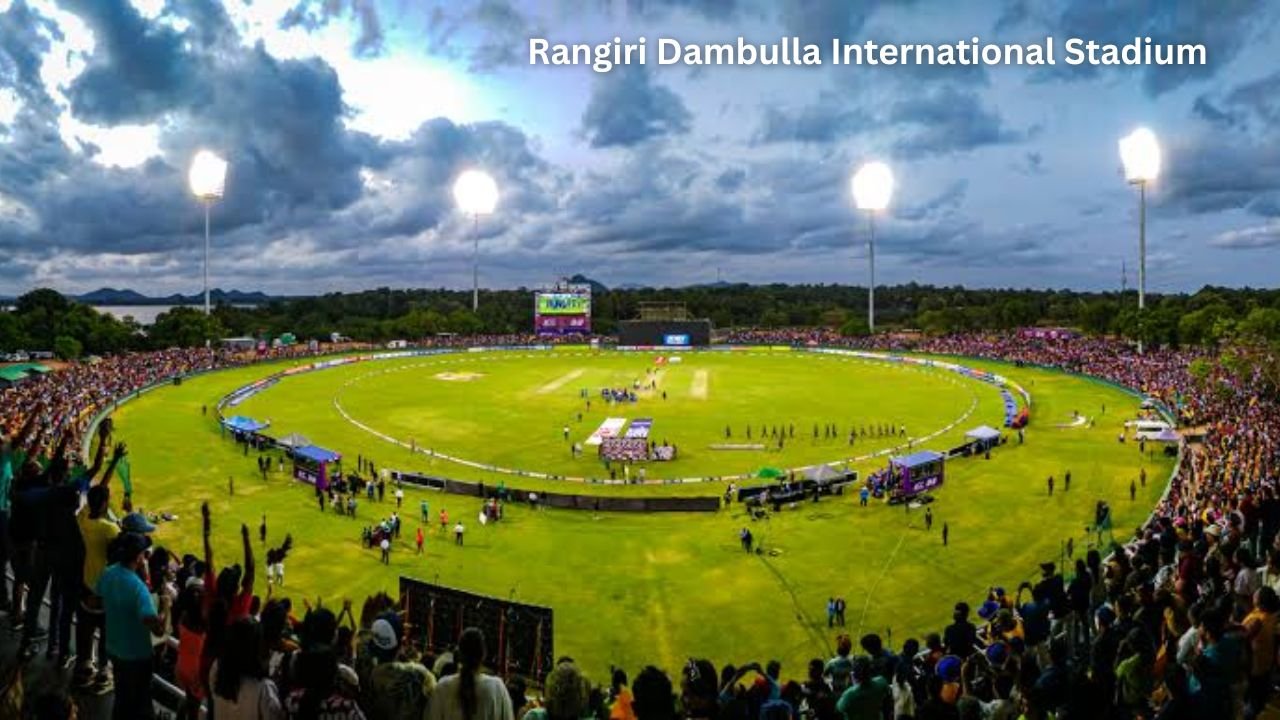
Rangiri Dambulla International Stadium: Location, Pitch Report, Weather, Capacity, Records & More
Rangiri Dambulla International Stadium is a prominent international cricket ground located in the ancient city of Dambulla, Sri Lanka. The ground is especially known as a limited-overs ground and has held numerous ODI and T20I matches, including Sri Lanka national cricket team and other foreign sides.
Built in 2000, the ground is set amidst scenic surroundings located near some of Dambulla’s famous landmarks. The surface inherently offers something for batsmen as well as bowlers, but this Track tends to get slower as the game progresses.
Rangiri Dambulla International Stadium Overview
| Feature | Details |
| Stadium Name | Rangiri Dambulla International Stadium |
| Location | Dambulla, Sri Lanka |
| Established | 2000 |
| Country | Sri Lanka |
| Capacity | Approximately 16,800 |
| Home Team | Sri Lanka |
| Floodlights | Yes |
| Ends | Press Box End, Scoreboard End |
| Time Zone | UTC +5:30 |
| Main Formats | ODI, T20I |
| Surface | Grass pitch |
| First ODI | Sri Lanka vs England, 2001 |
The venue was constructed in just 167 days and has become an important limited-overs cricket ground in Sri Lanka.
Rangiri Dambulla International Stadium Location
Related articles: The stadium is in Dambulla, near Sri Lanka’s Central/North Central region and not very far from the world-famous Dambulla cave temple as well as Dambulla Rock. Its setting of it lends a unique background in relation to many traditional Cricket grounds.
Located next to Dambulla Tank, it also has a picturesque backdrop.
How to Reach Rangiri Dambulla International Stadium
Access to Dambulla is primarily via road within the cities and several major highways accessible from Sri Lanka, especially between Colombo, Kandy and other tourist areas of the Kandy Region. Dambulla is an important transport hub in central Sri Lanka, which means that the stadium can be reached by road and via public transport.
The main entrance of Colombo for foreign visitors, while Dambulla can be reached by road.
Rangiri Dambulla Stadium Capacity
The stadium has a slightly different seating capacity, more than 16,800 seats according to reports.
Located with floodlights, the venue where it has subsequently hosted day-night cricket following its lighting facilities being brought up to international standards.
Rangiri Dambulla International Stadium Pitch Report
Rangiri Dambulla pitch rarely has strongly-offered help for the bowler; conditions can change during an innings, but generally it is quite a good batting surface.
The new surface is generally good for batting, and the ball tends to have some bounce on it initially. However, as the pitch dries and wears, it tends to slow down a touch and provide extra support for spinners and bowlers using variations.
Is Dambulla Stadium Pitch Batting or Bowling Friendly?
The answer depends on the format and condition of the particular surface.
| Stage of Match | Pitch Behaviour |
| Early Overs | Good pace and relatively true bounce |
| Middle Overs | Surface can become slower |
| Later Overs | Spin and slower variations can become effective |
| Morning | Seam movement can be available |
| Dry Conditions | Spinners can get more grip |
Fast bowlers can find some assistance early, while spinners may become more influential as the surface dries.
Rangiri Dambulla International Stadium Weather
Dambulla normally has a tropical warm climate with temperatures regularly assessed in the 20s as well as high-30s (°C) like most other Sri Lankan urban zones. Humidity can also be significant.
As is the case with Sri Lanka monsoon winds, rainfall can alter playing conditions in some seasons.
Weather Conditions and Cricket
Weather can play a crucial role in the pitch:
- There might be some help for seamers with humidity
- Dew in the morning aids the new ball to move.
- The pitch can be slower in hot and dry conditions.
- In damp spells from rain, matches can be disrupted.
- Evening conditions may influence dew in limited-overs games.
Hence, before finalising their bowling and batting strategy, teams usually assess the weather and the pitch.
Rangiri Dambulla ODI Records
The stadium has hosted a large number of ODI matches. Current ground statistics list 70 ODIs, with 33 wins for teams batting first and 34 for teams bowling first.
| ODI Record | Details |
| Matches | 70 |
| Batting First Wins | 33 |
| Bowling First Wins | 34 |
| Average 1st Innings Score | 213 |
| Average 2nd Innings Score | 175 |
| Highest Total | 385/7 |
| Highest Successful Chase | 289/4 |
| Lowest Defended Total | 156/8 |
The highest ODI total at the ground is 385/7 by Pakistan against Bangladesh.
Rangiri Dambulla T20I Records
Dambulla has also become a regular venue for T20 cricket. Current ground statistics list 31 T20 matches in the relevant record set, with teams bowling first winning 18 times compared with 13 wins for teams batting first.
| T20 Record | Details |
| Matches | 31 |
| Batting First Wins | 13 |
| Bowling First Wins | 18 |
| Average 1st Innings Score | 145 |
| Average 2nd Innings Score | 124 |
| Highest Total | 209/5 |
| Highest Chase | 180/5 |
| Lowest Defended Total | 108 |
Afghanistan recorded the venue’s highest listed T20 total of 209/5 against Sri Lanka.
Rangiri Dambulla Highest Score
The highest ODI team total at the stadium is:
| Team | Score | Opposition | Format |
| Pakistan | 385/7 | Bangladesh | ODI |
In T20 cricket, Afghanistan’s 209/5 against Sri Lanka is the highest listed total at the venue.
Rangiri Dambulla Highest Successful Chase
The ground has witnessed some impressive run chases.
| Format | Score Chased | Team | Opposition |
| ODI | 289/4 | Sri Lanka | Pakistan |
| T20 | 180/5 | West Indies | Sri Lanka |
These stats demonstrate that despite it becoming a nightmare for batting, Dambulla can also host successful high-pressure chases, so long as the pitch stays kind.
Rangiri Dambulla Boundary Length
The boundaries can change based on the match, but existing data from the ground usually has the boundaries less than 60–70+ meters.
The longest boundary is said to be about 72 metres and the shortest around 66 metres.
| Boundary | Approximate Distance |
| Shortest | 66 m |
| Longest | 72 m |
These dimensions can provide opportunities for powerful batters, although the exact boundary placement may change for different matches.
Toss at Rangiri Dambulla Stadium
Dambulla toss decisions could be highly influenced by the nature of the format and current pitch condition as well.
In recent T20 cricket, batting first has become an appealing tactic on a surface that is good for hitting early on and then slows. There has been a recent observation in the LPL that teams have favoured getting runs on the board before it gets more challenging to bat.
But the captains also have to think about:
- Dew
- Humidity
- Cloud cover
- Pitch dryness
- Match format
- Recent scores at the venue
Hence, there are no rigid toss rules applied to each game.
Rangiri Dambulla Stadium Best Score
We’ve seen some great individual and team performances on the ground.
Shikhar Dhawan‘s unbeaten 132 is one of the evergreen ODI batting records, while we have seen some big bowling performances at this venue as well.
| Record | Performance |
| Notable ODI Individual Score | 132* – Shikhar Dhawan |
| Highest ODI Team Total | 385/7 – Pakistan |
| Highest T20 Team Total | 209/5 – Afghanistan |
| Highest ODI Chase | 289/4 – Sri Lanka |
Rangiri Dambulla Stadium Bowling Conditions
The ground has been known to have interest for both fast bowlers as well as spinners.
Fast Bowlers
The new ball is known to swing in the air and seam on any moisture, whether from the surface or due to humidity. Discipline in line and length has often been more effective than merely speed.
Spinners
With a drying pitch, spinners can often become more relevant in the second innings. If the surface is slow, playing attacking shots down the line can be difficult.
Death Bowling
If it begins to slow down, the bowlers who have cutters, slower balls and changes of pace might get some assistance from the surface in T20 cricket.
Best Batting Strategy at Dambulla
The manner in which the batters go about their business should also reflect the state of the wicket.
In the earlier overs of a match, the surface is much easier for stroke-making when the ball comes on to the bat. But when the pitch does slow down, then batters will have to depend heavily on their placements, running between wickets, and calculated simmering aggression.
An ideal strong batter at this venue will perform:
- Watch the ball closely.
- Avoid unnecessary risks early.
- Rotate the strike.
- Target loose deliveries.
- Adjust to slower bowling.
- If a shorter boundary is available, use it.
Rangiri Dambulla International Stadium Famous Matches
The stadium has hosted numerous international fixtures involving Sri Lanka and visiting teams. Its first ODI was played between Sri Lanka and England in March 2001.
The venue has subsequently hosted cricket involving teams such as India, Pakistan, Australia, New Zealand, Bangladesh and other international sides.
Also Explore: Highest Wicket Taker in World Cup | Best Cricket Academy in India
Rangiri Dambulla International Stadium Major Facts
| Fact | Information |
| Opened | 2000 |
| Location | Dambulla, Sri Lanka |
| Capacity | Approx. 16,800 |
| International Formats | ODI & T20I |
| Home Team | Sri Lanka |
| Ends | Press Box End, Scoreboard End |
| Floodlights | Yes |
| First ODI | Sri Lanka vs England |
| Highest ODI Total | 385/7 |
| Highest T20 Total | 209/5 |
| Longest Boundary | Approx. 72 m |
| Shortest Boundary | Approx. 66 m |
Why Rangiri Dambulla International Stadium Is Important
The use of Rangiri Dambulla International Stadium has become an essential part of Sri Lanka’s one-day arena. Located in the midst of hills and a cricket stadium that changes every time, Shere Bangla has its own identity as an international venue.
While the pitch can offer assistance to batters in the early overs of an innings, it becomes more conducive to spin and slower bowling later on. The balance renders tactical calls, particularly around bowling changes and tempo in the batting order, to be of immense significance.
Frequently Asked Questions
Q-1/ Where is Rangiri Dambulla International Stadium located?
It is located in Dambulla, Sri Lanka, close to the Dambulla Cave Temple and Dambulla Rock.
Q-2/ What is the capacity of Rangiri Dambulla Stadium?
The current commonly listed seating capacity is approximately 16,800 spectators.
Q-3/ Is Dambulla a batting pitch?
The pitch can support batting early in an innings, but it may slow down and provide more assistance to spinners as the match progresses.
Q-4/ What is the highest ODI score at Dambulla Stadium?
The highest listed ODI team total is 385/7 by Pakistan against Bangladesh.
Q-5/ What is the highest T20 score at Rangiri Dambulla?
Afghanistan recorded the highest listed T20 total of 209/5 against Sri Lanka.
Q-6/ Does Dambulla Stadium host Test matches?
The stadium is primarily associated with ODI and T20 cricket and is not a regular Test venue.
Conclusion
Of all stadiums in Sri Lanka for technical limited-overs cricket, Rangiri Dambulla International Stadium may be the most recognisable. The ground is located at Dambulla and provides a beautiful backdrop, but with the same pitch that possesses plenty of help to both batters and bowlers.
With an estimated capacity of 16,800, the ground stages ODI and T20I cricket and is home to a record ODI total of 385/7 by Pakistan as well as a highest score in T20 cricket: Afghanistan’s 209/5.
The most interesting aspect of Dambulla for players and fans is the varied behaviour of the pitch. The surface is always good for batters in the opening, while spinners and variation officers will also have more impact as the match levels.
Also Explore: Slowest Century in ODI | India Qualification Scenario for Semi Final